



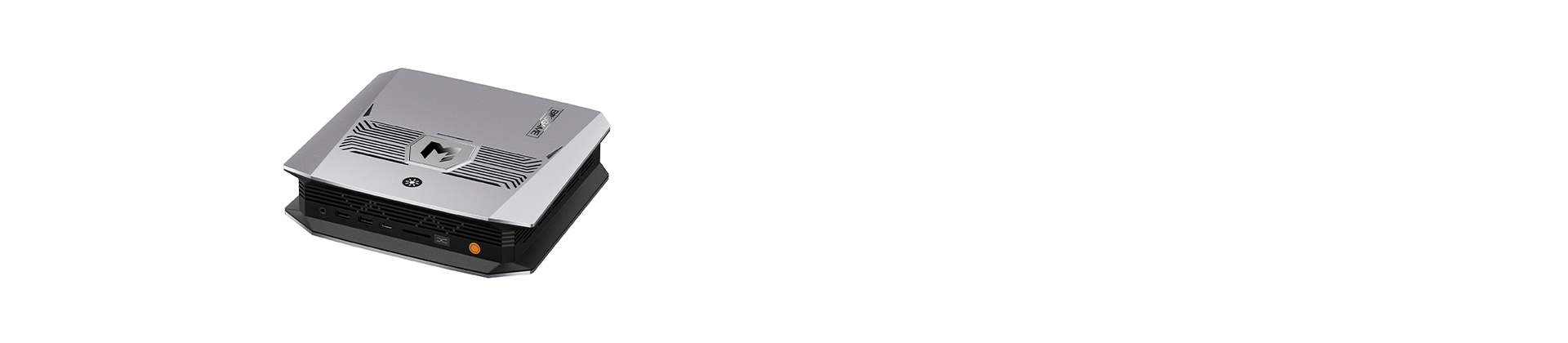

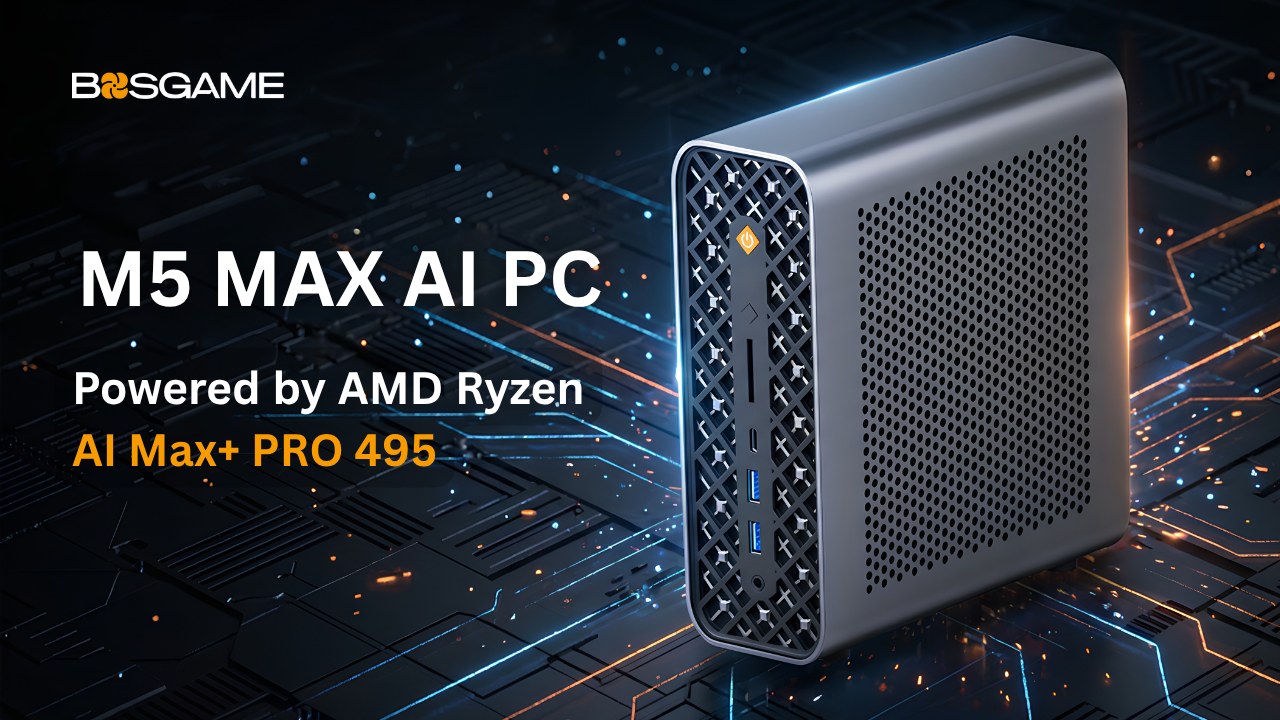
The BOSGAME M5 Max AI mini PC is set to launch soon, purpose-built for intensive AI tasks and professional-grade workloads. The initial release will feature a 128GB+2TB configuration in November 2026, with a 192GB+2TB version arriving in early 2027. This article will take a closer look at three key aspects of the M5 Max: its processor, high-capacity unified memory, and AI computing performance.
What Processor Powers the BOSGAME M5 Max AI Mini PC?
At the core of the M5 Max AI mini PC's performance is its processor. From the underlying architecture to its real-world compute power, every layer is built to handle demanding AI and professional workloads. Here's a closer look at what powers the M5 Max — starting with its architecture and core performance.
Architecture
The BOSGAME M5 Max AI mini PC is powered by the AMD Ryzen AI Max+ PRO 495, built on AMD's Zen 5 architecture and manufactured using TSMC's 4nm process (codenamed "Gorgon Halo"). As AMD's latest generation of AI-focused processors, it represents a meaningful step up in both efficiency and raw performance compared to earlier architectures, laying the foundation for the processor's strong multitasking and AI capabilities.
Core Performance
The Ryzen AI Max+ PRO 495 features 16 cores and 32 threads, giving it the ability to handle many demanding tasks at once — whether you're running an AI model, editing video, or multitasking across several applications simultaneously. This makes it especially well-suited for professional and creative workloads where multiple processes compete for CPU resources.
Clock speeds range from a 3.1GHz base frequency up to 5.2GHz max boost, allowing the processor to ramp up performance for demanding, single-threaded tasks while maintaining efficiency during everyday use. Backed by 16MB of L2 cache and 64MB of L3 cache, the processor can keep frequently accessed data close at hand, reducing the need to fetch data from system memory and improving performance in data-intensive workloads like AI inference and rendering.
What Memory Does the BOSGAME M5 Max AI Mini PC Offer?
Memory is where the M5 Max AI mini PC truly sets itself apart. Beyond simply offering a large capacity, its memory system is designed to work differently from most PCs. Here's a closer look at the memory specifications behind the M5 Max, and the architecture that makes them so effective.
Memory Specifications
The AMD Ryzen AI Max+ PRO 495 processor inside the BOSGAME M5 Max AI mini PC supports up to 192GB of memory, using a 256-bit LPDDR5x memory interface running at speeds of up to LPDDR5x-8533. This combination of high capacity and high bandwidth gives the M5 Max the memory headroom needed for demanding AI and professional workloads, well beyond what typical mini PCs offer.
Unified Memory Architecture
Most PCs with a discrete graphics card rely on two separate memory pools: system RAM for the CPU, and dedicated VRAM for the GPU. These pools don't share capacity — if your GPU only has 12GB of VRAM, it can't tap into the system's 64GB of RAM even when that memory sits idle. For AI workloads that require loading large models into memory, this separation quickly becomes a hard ceiling.
The BOSGAME M5 Max AI mini PC takes a different approach. Its AMD Ryzen AI Max+ PRO 495 processor uses a unified memory architecture, meaning the CPU, GPU, and NPU all draw from the same shared memory pool. Instead of splitting resources into isolated pockets, any of the three processing units can access as much of that shared pool as a given task requires.
This is especially valuable for running large language models locally. A model that requires more VRAM than a discrete GPU provides can become difficult or impossible to run entirely on the GPU, even when substantial system RAM is available. With unified memory, the M5 Max's GPU can draw on the full memory pool, making it possible to run far larger models on a compact mini PC than traditional discrete-GPU systems of similar size and price.
What’s the AI performance of BOSGAME M5 Max AI mini PC?
BOSGAME M5 Max AI mini PC delivers up to 131 TOPS of total AI compute, with the NPU alone contributing up to 55 TOPS, enabling large language models to run locally and offline — without relying entirely on the cloud for inference. This powerful, stable performance provides the compute foundation for AI development, model inference, and local AI applications, bringing flagship-level local AI capability to a compact mini PC. With this level of AI compute headroom, the M5 Max can deliver faster response times, even when handling larger and more demanding AI models.
Running AI locally also means sensitive or private data — documents, code, or personal files you'd rather not upload to a third-party cloud service — can be processed entirely on-device, without ever leaving the machine.
Conclusion
Together, the advanced processor, unified memory system, and AI compute give the BOSGAME M5 Max AI mini PC a level of performance rarely seen in such a compact form factor. Whether running large language models locally, handling demanding creative workloads, or multitasking across professional applications, the M5 Max is built to keep pace. Stay tuned for the official launch of the BOSGAME M5 Max and discover what this next-generation AI mini PC can do.