





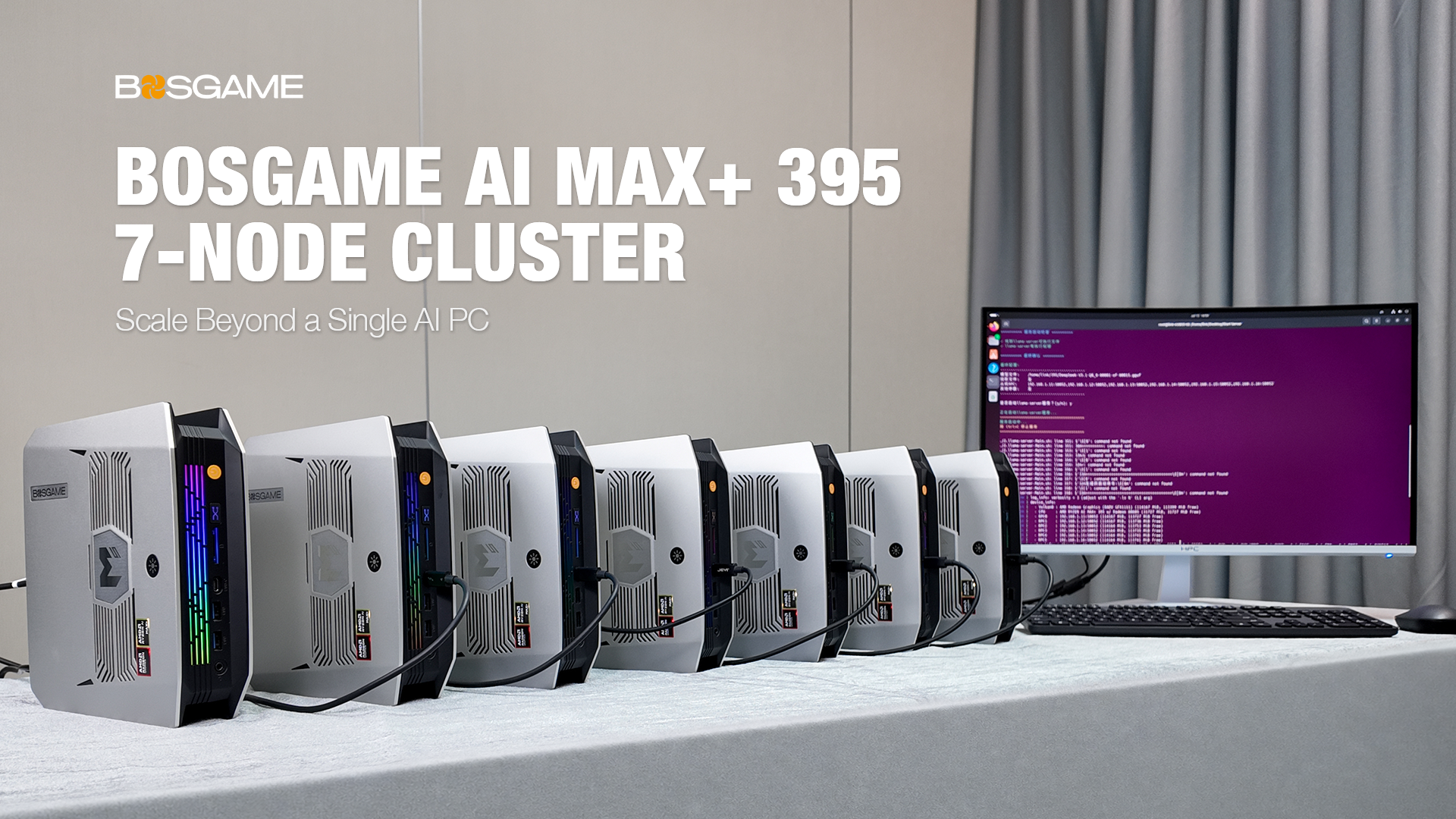
BOSGAME 7-Node AI MAX+ 395 Cluster Runs Large AI Models
Artificial intelligence models are growing rapidly in size and capability.
As large language models continue expanding, traditional single-device computing solutions may struggle to provide enough memory and processing resources for advanced AI workloads.
To explore a more flexible approach, BOSGAME developed a 7-node AI Cluster based on multiple M5 AI Mini PCs working together as a distributed AI computing platform.
This demonstration shows how compact AI computing devices can be combined to support large-scale local AI applications.
Building a 7-Node AI Cluster with BOSGAME M5
The BOSGAME AI Cluster consists of seven M5 AI Mini PCs connected through USB4 Direct Connection.
Instead of relying on a single high-end AI server, each M5 system contributes its own computing resources to create a distributed AI platform.
The combined system delivers:
- 7 interconnected AI computing nodes
- 896GB total Unified Memory
- Up to 672GB GPU-accessible unified memory across the cluster
- Distributed processing capability for large AI models
This modular architecture allows multiple compact systems to operate together as a scalable AI computing environment.
Running DeepSeek-V3.1 671B Locally Through Distributed Inference
One of the key demonstrations of the BOSGAME AI Cluster is distributed inference of the DeepSeek-V3.1 671B-parameter model.
Large language models with hundreds of billions of parameters require substantial memory capacity.
By distributing workloads across multiple M5 nodes, the cluster can support models that may exceed the limitations of a single AI PC.
This demonstrates the potential of Mini PC-based clusters for advanced local AI inference.
Why Use Multiple AI Mini PCs?
Traditional AI infrastructure often relies on large centralized servers.
However, a cluster built from AI Mini PCs provides a different approach.
Multiple smaller systems offer several advantages:
- Flexible hardware scaling
- Modular deployment
- Easier expansion
- Adaptable computing capacity
Users can gradually increase computing resources by adding additional nodes instead of replacing the entire system.
USB4 Direct Connection Enables Efficient Collaboration
High-speed communication between nodes is essential for distributed computing.
The BOSGAME AI Cluster uses USB4 Direct Connection as a high-bandwidth link between M5 nodes, enabling efficient data exchange during distributed AI workloads.
This architecture reduces the hardware complexity compared with traditional server-based AI setups.
Beyond AI Inference: A Platform for Local AI Development
The BOSGAME M5 AI Cluster is not limited to model inference.
The platform can support various AI computing workflows, including:
- Local LLM inference
- AI application development
- Software debugging and testing
- AI model testing and experimentation
- Edge AI deployment
- AI research workflows
By keeping AI workloads locally, developers and organizations can maintain greater control over their computing environment and data.
A New Direction for AI Computing
The BOSGAME 7-node AI Cluster demonstrates how compact AI systems can be combined to create powerful computing platforms.
Instead of depending only on traditional AI servers, users can explore scalable architectures built from modular AI Mini PCs.
As AI models continue evolving, distributed computing solutions will provide new possibilities for local AI deployment.
Conclusion
The BOSGAME M5 AI Mini PC Cluster showcases how seven compact AI systems can work together to support advanced AI workloads.
Through distributed inference, high-capacity memory resources, and modular expansion, the cluster provides a flexible approach for supporting large language model inference locally.
This demonstration represents BOSGAME’s continued exploration of accessible, scalable private AI computing.