




Running AI models locally often hits a common bottleneck: limited GPU memory. Large language models, AI image generation, and resource-heavy tasks can exhaust VRAM quickly. That makes the underlying memory architecture critical for real-world AI PC performance.
As AI workloads become more demanding, having enough memory is only part of the equation. How that memory is shared between the CPU, GPU, and NPU can also affect how effectively an AI PC handles local workloads.
What Is Unified Memory?
Unified memory is a memory architecture in which the CPU, GPU, and NPU can access a shared memory pool, depending on the system design.
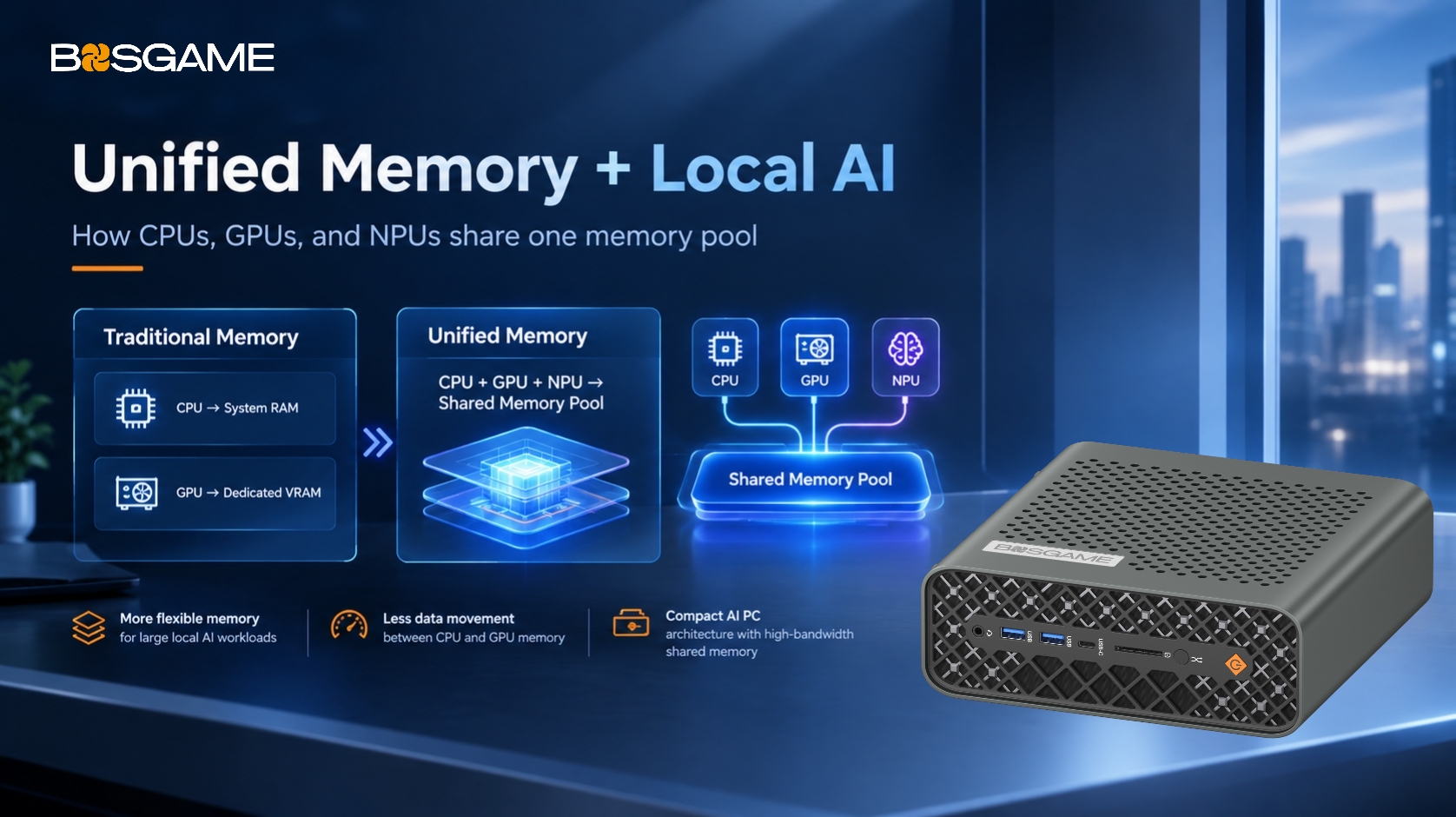
Traditional PCs with discrete GPUs typically use separate memory pools. The CPU works with system RAM, while the GPU relies on dedicated VRAM. This separation can become a limitation when AI models require more memory than the GPU's available VRAM.
With a unified memory architecture, CPU, GPU, and NPU resources can access the same shared memory pool, providing greater flexibility for memory-intensive workloads.
Unified Memory vs. Traditional Memory
Traditional architecture
CPU → System RAM
GPU → Dedicated VRAM
Unified memory architecture
CPU + GPU + NPU → Shared Memory Pool
The key difference is how memory resources are organized. With traditional architectures, CPU memory and GPU memory are separated. With unified memory, the available memory can be accessed by different processing units according to the system design and workload requirements.
Why Does Unified Memory Matter for Local AI?
More Memory for Larger AI Workloads
Local AI applications can require significant amounts of memory. Large language models, image-generation models, and other AI workloads may quickly exceed the VRAM available on a conventional GPU.
A larger shared memory pool can give AI workloads more memory to work with, making it possible to handle larger models and datasets within a compact system.
This is particularly relevant for AI PCs, where users may want to run models locally rather than relying entirely on cloud services.
Less Separation Between CPU and GPU Memory
In a traditional system, data may need to move between system RAM and dedicated VRAM when both the CPU and GPU need access to the same information.
A unified memory architecture reduces this separation by allowing the CPU, GPU, and NPU to work with a shared memory pool. The NPU can also access the same memory pool, helping accelerate AI workloads such as local AI inference, depending on the system design.
This can simplify data access and improve memory efficiency for certain AI workloads.
Better Fit for Compact AI PCs
AI PCs are designed to deliver more computing capability in smaller form factors. However, compact systems have limited physical space for components such as dedicated GPU memory.
Unified memory provides another way to design high-memory AI systems without relying on a separate VRAM pool. This makes the architecture particularly interesting for compact AI PCs focused on local AI workloads.
Does Unified Memory Make Every AI Workload Faster?
Not necessarily.
Unified memory does not automatically make every workload faster. Overall performance still depends on the processor, GPU architecture, memory bandwidth, software optimization, cooling, and the specific AI workload.
The main advantage is flexibility: CPU, GPU, and NPU can work with a shared memory pool, subject to hardware and software implementation.
For local AI, this can be especially useful when memory capacity becomes a limiting factor.
How BOSGAME AI PCs Put This into Practice
BOSGAME AI PCs are designed around the needs of modern local AI workloads, combining powerful processors with large memory capacities and high-bandwidth memory architectures.
By bringing CPU, GPU, and NPU computing together with shared memory, BOSGAME AI PCs can provide a compact platform for applications such as local AI inference, content creation, development, and multitasking.
Instead of focusing solely on raw processor performance, our design prioritizes overall system architecture — including memory capacity, bandwidth, and how different computing units access that memory — which plays an important role in the local AI experience.
Conclusion
Unified memory gives local AI PCs greater flexibility when handling memory-intensive workloads. By allowing CPU, GPU, and NPU resources to access a shared memory pool, this architecture can better support demanding AI applications in compact systems.
More flexible memory. More possibilities for local AI.