




Why Businesses Are Replacing Desktop PCs with Mini PCs
For many years, traditional desktop computers were the standard choice for offices, schools, retail environments, and enterprise workstations.
Today, that trend is changing.
As businesses modernize their IT infrastructure, Mini PCs are becoming an increasingly popular alternative. Advances in processor performance, graphics capabilities, networking, and connectivity now allow compact systems to deliver the performance businesses need without the size and complexity of traditional desktop towers.
So why are more organizations making the switch?
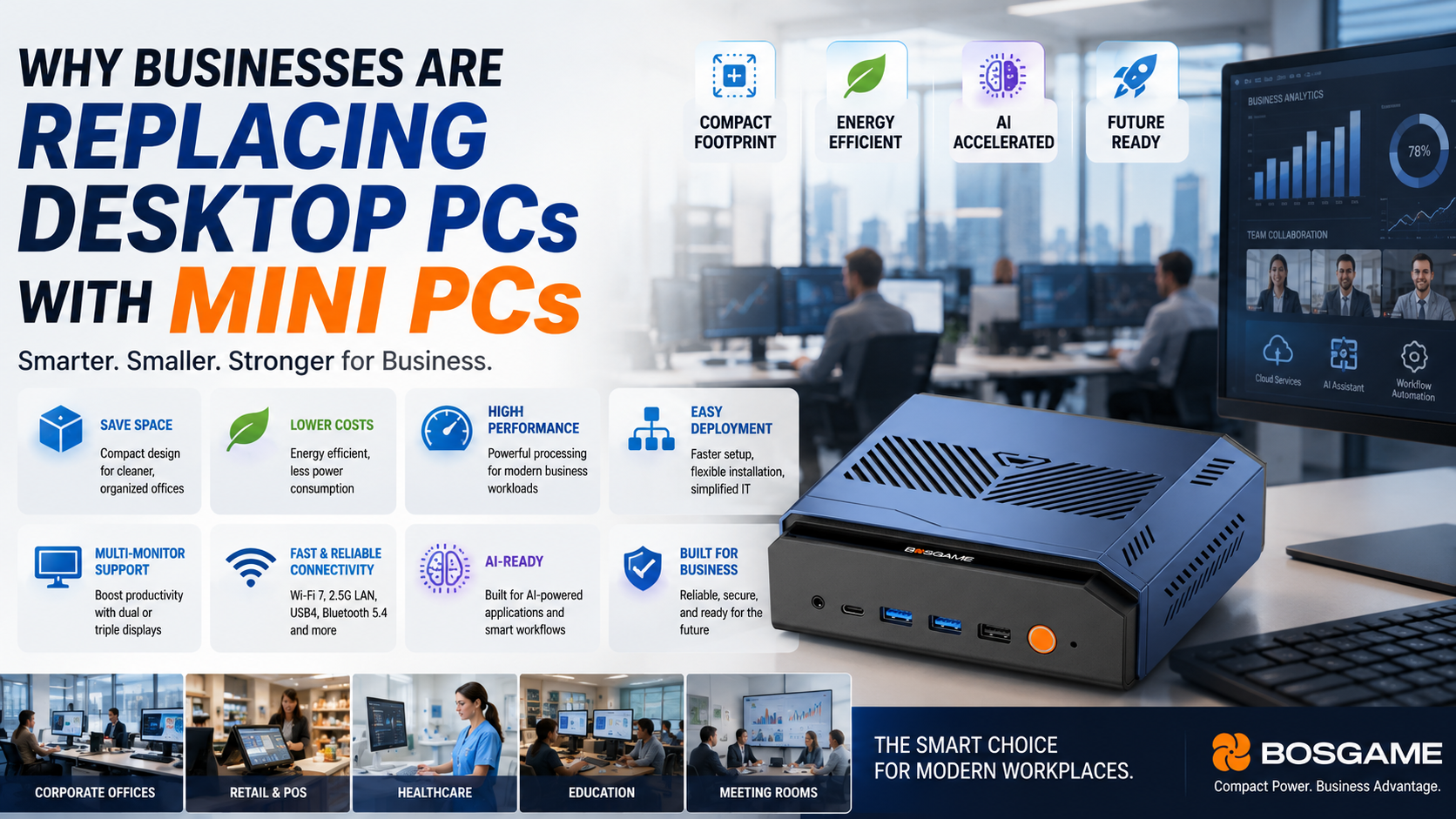
Maximizing Office Space
Office space is valuable.
Large desktop towers occupy significant desk space and often require dedicated floor placement, creating clutter and reducing workspace flexibility.
Mini PCs offer a much smaller footprint while still providing the computing power needed for everyday business applications.
Their compact design allows businesses to:
- Create cleaner workstations
- Increase available desk space
- Build more organized office environments
- Improve overall workspace aesthetics
For organizations with hundreds of employees, these space savings can make a noticeable difference.
Lower Energy Consumption
Reducing operating costs is an important goal for every business.
Modern Mini PCs are designed with energy-efficient processors that deliver strong performance while consuming less power than many traditional desktop systems.
Lower energy consumption can contribute to:
- Reduced electricity costs
- Lower heat generation
- Quieter working environments
- Improved sustainability initiatives
For businesses operating large numbers of computers, even modest energy savings can have a meaningful impact over time.
Performance That Meets Modern Business Needs
Today's office workloads are very different from those of a decade ago.
Employees regularly work with:
- Cloud-based applications
- Video conferencing platforms
- Large spreadsheets
- Business analytics tools
- Creative software
- AI-assisted productivity applications
Modern Mini PCs are capable of handling these workloads efficiently thanks to the latest processors, fast memory, high-speed storage, and advanced graphics technologies.
Easier Deployment Across the Organization
Managing dozens—or even hundreds—of computers becomes much simpler when systems are compact and standardized.
Mini PCs offer several deployment advantages:
- Faster workstation setup
- Flexible installation options
- Simplified cable management
- Easier transportation between offices
Their small size also makes them ideal for meeting rooms, reception desks, classrooms, and customer service counters.
Better Support for Multi-Monitor Workstations
Many business professionals rely on multiple displays to improve productivity.
Departments such as:
- Finance
- Software development
- Customer support
- Digital marketing
- Engineering
Often benefit from dual or triple monitor setups.
Modern Mini PCs support multiple high-resolution displays, allowing employees to manage more information simultaneously without requiring bulky desktop hardware.
Reliable High-Speed Connectivity
Business computing depends on stable and fast connectivity.
Many modern Mini PCs provide enterprise-ready features such as:
- Multi-Gigabit Ethernet
- Wi-Fi 7
- Bluetooth 5.4
- Thunderbolt™ 4 or USB4
- High-speed USB connectivity
These technologies support faster file transfers, reliable conferencing, cloud collaboration, and efficient peripheral connectivity.
Supporting the Growth of AI in the Workplace
Artificial intelligence is becoming part of everyday business software.
Modern workplaces increasingly rely on AI for:
- Document summarization
- Meeting transcription
- Intelligent search
- Data analysis
- Image enhancement
- Workflow automation
AI-ready Mini PCs equipped with modern processors and dedicated AI acceleration help organizations take advantage of these new capabilities while maintaining compact and efficient workstations.
Flexible for Different Business Environments
Mini PCs are suitable for a wide range of industries.
Common deployment scenarios include:
- Corporate offices
- Small businesses
- Retail stores
- Healthcare facilities
- Educational institutions
- Digital signage systems
- Reception areas
- Meeting rooms
Their versatility allows organizations to standardize hardware across multiple departments while meeting different operational requirements.
Lower Maintenance and Cleaner Workspaces
A smaller computer often means a simpler workspace.
Compact systems reduce cable clutter and make desks easier to clean and organize.
For IT departments, standardized Mini PC deployments can simplify installation, workspace planning, and ongoing hardware management.
This contributes to a more efficient and professional office environment.
Preparing for the Future of Business Computing
As businesses continue adopting cloud services, AI-powered software, hybrid work models, and digital collaboration tools, compact computing solutions are becoming increasingly practical.
Mini PCs now provide the performance, connectivity, and flexibility required for modern business environments while occupying significantly less space than traditional desktop towers.
For many organizations, they represent a long-term investment in efficient and scalable workplace technology.
Conclusion
The transition from traditional desktop PCs to Mini PCs reflects a broader shift in how businesses approach computing.
By combining powerful performance with compact design, energy efficiency, modern connectivity, and AI readiness, Mini PCs offer an ideal solution for organizations seeking to optimize both workspace and productivity.
As workplace technology continues to evolve, Mini PCs are positioned to become a key part of the modern business environment, helping companies build smarter, more efficient, and future-ready offices.